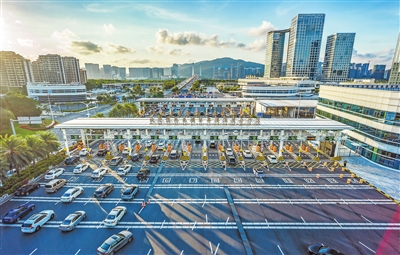
The second-line customs passage at Hengqin Bridge.
During his December 2024 visit to the Guangdong–Macao In-Depth Cooperation Zone in Hengqin, General Secretary Xi Jinping remarked that it was a new idyllic land where fields could be cultivated. His words gave poetic expression to the possibilities of this 106-square-kilometre area and pointed toward the new positioning of Macao plus Hengqin.
This year marks five years since the release of the Master Plan for the zone and its inauguration. How has Hengqin's industrial landscape advanced after five years of cultivation?
The figures offer a clear answer. In 2025, the zone's GDP reached RMB 54.705 billion, up 20.3% from 2021. The four emerging industries generated RMB 36.707 billion in added value, accounting for 67.1% of GDP. That exceeded the 65% target set for 2029 in the zone's overall development plan four years ahead of schedule.
Over five years, the zone's Economic Development Bureau, responsible for coordinating technology R&D and high-end manufacturing, Macao-branded industries including traditional Chinese medicine, and culture, tourism, conventions, exhibitions and commerce, has addressed three practical questions: where industries come from, how they establish deep roots and where future development should lead.
Through sustained effort, Hengqin has moved from establishing industries to improving their quality and strengthening their capabilities. Under the Macao plus Hengqin positioning, the two places have progressed from combining resources to deep collaboration. Guided by the three assessment questions for the zone's development, a clear path of industrial advancement has emerged.
Reporting and writing: Li Meiqi
Photography: Zhu Wen
Planning: a consistent blueprint and institutional innovation open the way
From the Master Plan to the zone's second phase of development and alignment with Macao's third five-year plan, the central challenge is turning the strategic principle of matching Macao's needs with Hengqin's strengths into practical, executable industrial plans.
With two currencies and separate customs territories, progress depends on bringing resources together and enabling their efficient movement across the border.
On March 1, 2024, the zone formally introduced separate customs administration, opening the first line between Macao and Hengqin while controlling the second line between Hengqin and the mainland. It became China's first area within the national territory but outside its customs territory to comprehensively combine tax exemptions, bonded treatment and tax refunds.
On the day the policy took effect, Hengqin Jieke Technology Co., Ltd. purchased goods from the mainland and applied for an export tax refund the following month, becoming one of the first Macao-invested companies to benefit.
Company head Chen Jiancai said that certain high-end instruments imported from Europe and the United States could enter Hengqin through Macao duty-free, bringing tangible benefits to businesses operating in Hengqin.
The institutional innovation also allows research resources and international talent to enter Hengqin more efficiently.
Jiang Zhaohui, a young entrepreneur from Macao and founder of Guangdong LeapFive Technology Co., Ltd., has experienced this directly. Jiang said Hengqin's proximity to Macao offers rapid access to international industry developments, university resources and high-level chip-design talent.
Over six years in Hengqin, LeapFive has grown from a start-up into a team of more than 100 people and launched several independently developed RISC-V chips with internationally competitive technology.
Its growth reflects an important change in industrial collaboration: Hengqin is becoming more than additional space for Macao's industries. It is increasingly a base for research, commercialization and production.
Over five years, the Economic Development Bureau has refined a competitive policy package around the zone's core industries. Measures include the two 15% tax incentives, dedicated industrial support policies and subsidies paid at 120% of the standard level for Macao residents and enterprises.
Businesses have responded to this tangible support. By the end of July 2026, the zone had more than 50,000 business entities, with leading companies such as ByteDance, Tmall, JD.com, Feihe, CATL and Airbus Helicopters establishing operations. As of July 31, 2026, Macao-invested enterprises exceeded 8,000, up 75.72% from the zone's inauguration in 2021.
As plans become reality, the two-way movement of rules, capital, talent and data is making Hengqin–Macao industrial collaboration smoother and broader.
Building momentum: emerging industries grow from individual projects into an ecosystem
Industrial development must be assessed not only by how many companies arrive, but also by whether industries achieve scale and competitiveness.
Over five years, the zone has developed a collaboration model combining Macao's platform, international resources, Hengqin's space and shared results across the four emerging industries.
Technology R&D and high-end manufacturing rank first among these industries. They offer some of Hengqin's greatest growth potential while also requiring long-term cultivation.
Integrated circuits and robotics involve long cycles, intensive R&D and gradual accumulation of expertise; a chip can take years to move from project approval to mass production, said AMicro Chairwoman Jiang Xinqiao. In her view, Hengqin's location next to Macao, clear industrial priorities and stable, inclusive policies provide the conditions innovation companies need to develop over time.
Hengqin provides policy support, including dedicated integrated-circuit measures addressing major cost pressures on chip designers. Macao connects companies with research resources. AMicro has established a joint laboratory drawing on the University of Macau's state key laboratory resources, obtained licenses to implement three core patents, and jointly trained more than 30 researchers from Macao.
From its establishment in 2014 to becoming Hengqin's first national specialized and innovative Little Giant enterprise, AMicro's development reflects the growth of the local integrated-circuit cluster.
Five years ago, AMicro was one of only a few chip-design companies on the island, Jiang said. Today, the zone has more than 100 integrated-circuit-related enterprises. Design firms collaborate locally, while design, testing, talent and capital have come together into an ecosystem.
The shift from isolated companies to an industrial cluster is reflected in the numbers. In the first half of 2026, added value in high-tech manufacturing rose 648.8% year on year, while manufacturing added value rose 314.4%. From January to May 2026, the scale of integrated-circuit enterprises above the designated size grew by more than 150% year on year.
Macao-branded industries, including traditional Chinese medicine, are another distinctive area of collaboration.
Macao's traditional Chinese medicine sector has established brands, research resources and international connections. To grow at scale, however, it must address production space, industrial support, registration, commercialization and market expansion.
The model of registration in Macao and production in Hengqin is giving longstanding Macao brands renewed momentum.
Cheong Lok Kei, the third-generation successor of Cheong Kun Pain Relief Oil, said Hengqin had provided modern production lines, enabled cross-border contract manufacturing and helped the brand register medicines overseas. It became one of the first proprietary Chinese medicines to enter Portuguese-speaking markets, with substantial improvements in product quality and competitiveness.
By the end of August 2026, nine enterprises and 81 products had been authorized to use the Made under Macao Supervision, Produced under Macao Supervision or Designed in Macao labels, connecting registration in Macao, production in Hengqin and overseas sales.
Culture, tourism, conventions, exhibitions and commerce focus on linking resources across the two places. Models such as one exhibition across two destinations, group entry and exit, and multi-destination itineraries are moving these industries toward coordinated development.
Since the group-entry-and-exit policy began in May 2024, the zone had organized more than 43,000 tour groups and received 224,000 visitor trips by the end of July 2026. In the first half of 2026, hotel occupancy averaged 60.61%. Foreign visitor arrivals through Hengqin Port exceeded 96,000, up approximately 76.9% year on year.
Establishing industries answers whether they exist; improving them answers how they compete. Technology R&D and high-end manufacturing emphasize commercialization, Macao-branded industries combine brands with Hengqin production, and tourism, exhibitions and commerce link the two places' resources.
Individual projects have grown into an expanding industrial ecosystem. The zone's industrial system is taking shape, while the breadth and depth of Hengqin–Macao integration continue to increase.
Removing barriers: institutional opening accelerates the movement of resources
A key measure of industrial integration is how quickly and precisely institutional innovation moves from broad policy arrangements into everyday business operations.
On August 26, the Hengqin upstream cargo terminal for Macau International Airport completed its first air-cargo pallet-building shipment and flight. Luo Rui of Guangdong Hengqin Cooperation Zone Youkua Supply Chain Co., Ltd. said cargo previously had to wait at the airport for unloading, inspection and pallet building—sometimes more than half a day during peak periods. Now shipments can move through as they arrive and fly as they are loaded. The new Hengqin–Macao air-freight model reduces both logistics time and business costs, making global cargo connections more accessible.
Institutional innovation is a means to remove barriers to industrial development. For the zone's more than 50,000 business entities, institutional opening means fewer hours waiting for cargo, lower logistics costs, more reliable deliveries and access to larger markets.
From upstream cargo terminals to cross-border road–air freight, from Hengqin Port to Macao vehicles with a single license plate, and from separate customs administration to easier cross-border fund transfers, physical and institutional connections are advancing together.
Over five years, the zone's total imports and exports reached RMB 158.1 billion. Passenger crossings through Hengqin Port exceeded 100 million, with daily crossings exceeding 100,000 and Macao residents accounting for more than a quarter. Customs processed more than 12.5 million vehicle crossings, growing at an annual average of over 33%. By the end of August, 2,582 enterprises were registered with Hengqin Customs, approximately 84% more than before the Master Plan was released.
The benefits of Macao plus Hengqin ultimately appear in shipments, invoices, cross-border journeys and specific orders. As people, goods, capital and information move more freely, smooth cross-border flows are becoming routine and policy possibilities are turning into usable business services.
Physical connections, compatible systems and closer personal ties are bringing Hengqin and Macao together. Their complementary industrial development is overcoming institutional barriers and opening new possibilities.
Nurturing enterprises: how Macao businesses grow in Hengqin
A thriving industrial ecosystem depends on deep roots as well as major companies. Alongside attracting large and strong enterprises, the zone increasingly focuses on cultivating local businesses so they can establish themselves, grow steadily and generate sustained industrial momentum.
He Guotao, a young Macao entrepreneur and founder of Puqiang Times (Zhuhai Hengqin) Information Technology Co., Ltd., recalled entering the first Hengqin International Scientific and Technological Innovation and Entrepreneurship Competition in 2018. The company had developed and commercially validated its in-vehicle intelligent voice-interaction technology. It needed a base suited to AI innovation, connected to the Greater Bay Area and offering an international gateway. The competition led the team to settle in Hengqin.
Why Hengqin? He said that beyond the RMB 100 million R&D support prize, the competition offered credibility, industry connections, trust between government and business, and access to the innovation ecosystem.
Hengqin supported the company's growth through government services, industrial infrastructure, cross-border talent and pilot applications. This helped it grow rapidly from a technical team and gain access to the Greater Bay Area's innovation ecosystem.
Today, Puqiang develops technology and industrial capabilities in Hengqin while building applications and overseas business through Macao. Its model combines foundational acoustic AI, domain-specific large models, validation in leading industry applications and deployment at scale through ecosystem partnerships. It provides intelligent solutions to dozens of Fortune Global 500 companies.
Its journey from a technology competition to a comprehensive business-service network reflects Hengqin's targeted support for emerging enterprises.
In August 2025, Puqiang joined the first cohort of the zone's enterprise cultivation and growth-support program. Its technology was maturing, flagship applications were being deployed and the company was entering a phase of scaled growth.
He described the program as highly targeted, continuous support. Proactive services and company-specific cultivation reduce burdens and help technology enterprises concentrate on R&D and business expansion.
Since the program began, service teams have followed a principle of responding when needed without unnecessary disruption. They have made more than 1,000 company visits, collected 293 requests and resolved over 96%, documenting close cooperation between businesses and government.
A year of sustained cultivation has produced visible results.
The first cohort included 89 seedling enterprises and 18 growth-support enterprises, with more than 119 additional companies expressing interest. Zhen Health Medical Technology became the zone's first locally cultivated company to list in Hong Kong, while United Biotechnology reached a US$2 billion licensing agreement with global pharmaceutical company Novo Nordisk.
Starting with 107 enterprises, the program is changing a landscape of small, weak and fragmented businesses into an industrial ecosystem. At its recent first-anniversary results event, the second cohort was announced and a new collaborative growth initiative launched, taking the enterprise support system into its next phase.
For Hengqin, a good business environment increasingly means providing a complete set of conditions for growth, rather than simply offering space.
Looking ahead: industrial priorities for the second phase
Five years is both a milestone and a new starting point.
In its first five years, the zone established its industrial foundations: clearer priorities, more space, faster project delivery, a growing concentration of businesses and initial collaboration mechanisms. The Economic Development Bureau also shifted from broad economic administration toward more focused industrial development.
The next five years require stronger quality and competitiveness. Success will depend not just on company and project numbers, but on complete industrial chains, sustained business growth and the ability to turn Macao's advantages into industrial competitiveness.
Cultivate specialized sectors. Within the four emerging industries, focus further on microelectronics, the digital economy and healthcare. Macao and Hengqin will coordinate targeted investment attraction and enterprise cultivation to build internationally competitive clusters.
Advance major projects. Accelerate key facilities including the Hengqin upstream cargo terminal for Macau International Airport, the Hengqin–Macao innovation industrial park and the convention and exhibition centre, using major projects to drive upgrading.
Align rules and mechanisms. Deepen coordination with Macao on resource flows, market access and industry standards. Explore more arrangements in which one service or policy works across both places, providing institutional support for industrial integration.
The next breakthrough in industrial collaboration depends on clearly defined roles and responsibilities.
Macao can act as a precise connector, focusing on its international gateway role, brand operations and global market development. Hengqin can concentrate on research, pilot production, mass production and industrial clustering.
This will give practical depth to the model of Macao's platform, international resources, Hengqin's space and shared results—the feature that distinguishes Hengqin–Macao integration from ordinary regional cooperation.
An Economic Development Bureau representative said the zone's objective had advanced from accelerating distinctive industries to building them at scale. The bureau has launched a 6+1 series of studies on Hengqin–Macao industrial collaboration to address underlying challenges and achieve substantive breakthroughs in integration.
With determination, Hengqin continues opening new ground.
Over the next five years, industrial integration between Hengqin and Macao is expected to enter a stronger and more ambitious chapter.
Five years in figures
• In 2025, the zone's GDP reached RMB 54.705 billion, up 20.3% from 2021. The four emerging industries generated RMB 36.707 billion in added value, or 67.1% of GDP, surpassing the 2029 target of 65% four years early.
• Over five years, the Economic Development Bureau introduced a competitive policy package including the two 15% tax incentives, dedicated industrial support and subsidies at 120% of the standard level for Macao residents and enterprises.
• By the end of July 2026, the zone had more than 50,000 business entities, including operations established by ByteDance, Tmall, JD.com, Feihe, CATL and Airbus Helicopters. As of July 31, Macao-invested enterprises exceeded 8,000, up 75.72% from the zone's 2021 inauguration.
• Over five years, total imports and exports reached RMB 158.1 billion. Hengqin Port handled more than 100 million passenger crossings, with daily crossings exceeding 100,000 and Macao residents accounting for over a quarter. Vehicle crossings exceeded 12.5 million, with average annual growth above 33%. By the end of August, 2,582 enterprises were registered with Hengqin Customs, approximately 84% more than before the Master Plan was released.