The 63rd ACM/IEEE Design Automation Conference (DAC 2026) recently concluded in Long Beach, USA. Established in 1964 and jointly organized by ACM and IEEE, DAC is a leading chip-design conference, often described as the industry’s “Oscars.” It is the only CCF-A international conference in EDA and one of the oldest and most influential academic conferences in chip design.
At the conference, AMicro’s university partners on a national research project—the team led by Professor Yu Zhiyi and Associate Professor Xiao Shanlin at Sun Yat-sen University’s School of Microelectronics Science and Technology—achieved a breakthrough in automated neuromorphic computing design. Their paper, “ACENAS: A ZeroCost NAS Framework for CoDesign of Architecture and Encoding in Spiking Neural Networks,” with student Qin Mingyu as first author, was accepted. The research was jointly supported by a key National Natural Science Foundation project and a Guangdong key R&D program.
Complementary research and engineering strengths advance neuromorphic computing
The work forms part of Guangdong’s major Brain Science and Brain-Inspired Research program. Led by Sun Yat-sen University, the project involves AMicro in core system architecture and commercialization tasks, combining original university research with industrial engineering.
The university team focuses on algorithms and theory. AMicro contributes neuromorphic chip and hardware expertise for system validation, application software and edge deployment. In April, the project passed its midterm review and received positive feedback from the expert panel.
ACE-NAS: the first zero-cost architecture search framework jointly designing SNN structure and encoding
Neuromorphic computing draws on biological information-processing mechanisms to achieve low-power, low-latency intelligence. Spiking neural network performance depends on both architecture and neural encoding. Existing search methods typically optimize architecture while using manually selected fixed encodings, limiting exploration of their coupled design space.
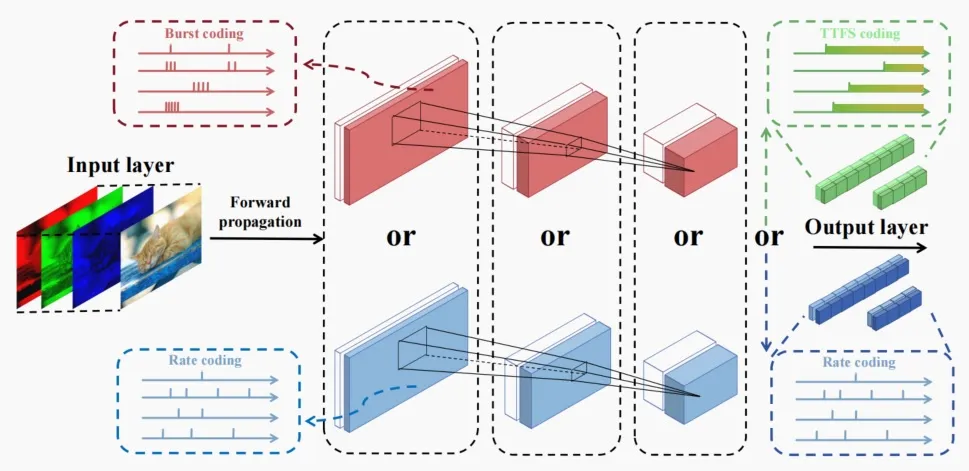
The team proposed ACE-NAS, the first zero-cost search framework for joint SNN architecture and neural encoding design. “Zero-cost” means candidate configurations can be explored without fully training each network.
ACE-NAS jointly searches network topology and layer-specific encodings, allowing heterogeneous combinations of Rate, Burst and Time-to-First-Spike (TTFS) encoding according to layer function. This reduces reliance on manual expertise. The Jacob_cov metric evaluates temporal representation across encodings without training. Combined with the ZiCo architecture metric and initial spike count as a dynamic energy proxy, multi-objective evolutionary search balances performance and spike overhead.
Improved performance and search efficiency gains of two orders of magnitude
Experimental results include:
• 92.95% classification accuracy on CIFAR-10;
• On Tiny-ImageNet-200, accuracy increased from AutoSNN’s 46.79% to 53.29%, while spike count fell from 680K to 269K, a reduction of more than 60%;
• A complete CIFAR-10 search took approximately 1 GPU hour, about 7 times faster than AutoSNN. Compared with conventional NAS methods, search time was reduced by more than two orders of magnitude.
The work extends automated SNN design from architecture-only search to joint architecture and encoding search, offering a new approach to accurate, low-spike, hardware-friendly networks.
Advancing commercialization and China’s neuromorphic intelligence industry
AMicro will deepen research partnerships with Sun Yat-sen University and other institutions, focusing on core neuromorphic technologies and accelerating engineering and commercialization of research results. Congratulations to Professors Yu Zhiyi and Xiao Shanlin, their team and Qin Mingyu on this academic achievement!